
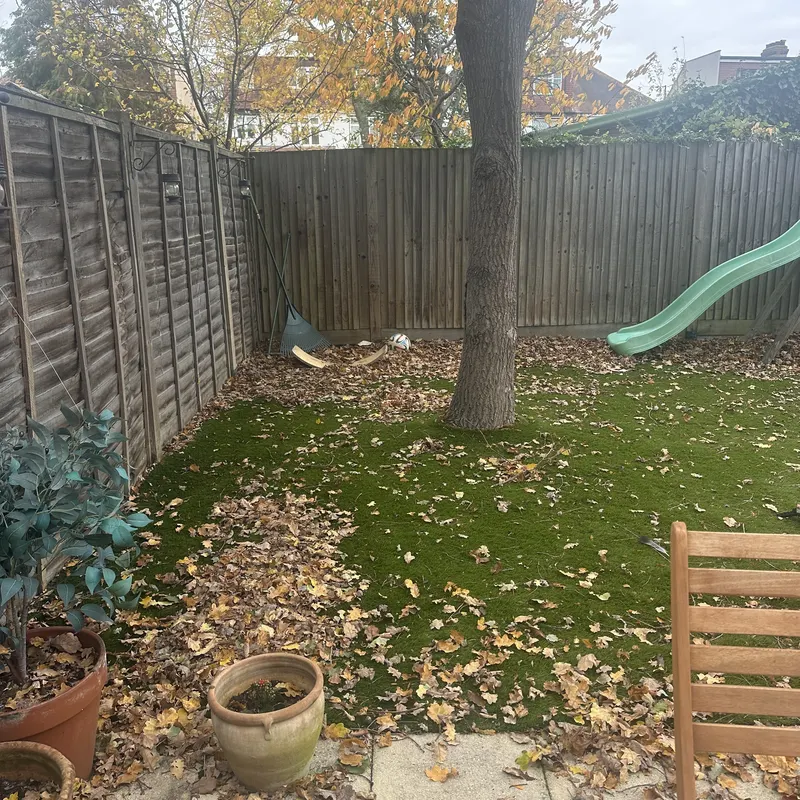
Which November jobs deserve a place on your list?
Begin with what you can see rather than transferring an entire national checklist into your diary. The garden may contain an open lawn, a few containers or mainly paving, so not every seasonal task applies. Use this page to choose relevant work and to note the conditions that would make you postpone it. Each physical task should have a clear place and purpose.
The RHS November lawn page recommends lifting leaves from grass. Its November flower advice includes tulip planting. These are starting points for choosing a task, not a statement that every London garden needs both. Read the relevant source before working with a plant or surface you do not understand, and leave uncertain identification for a separate discussion.
How can you organise leaf work without clearing the whole garden?
Identify the lawn sections where leaves have collected and choose where the gathered material will go before starting. Mark the intended collection point on a simple sketch. Keep that point distinct from the area you want left undisturbed so another person does not move a pile back into a place you have just finished.
Plan one complete route for the job: gather from a defined section, move the material to the selected place, then check the section before moving on. This avoids spreading partly completed work across every corner. If the garden contains artificial grass or gravel as well as natural turf, describe those separately when requesting help. The appropriate equipment and the material collected may differ, and a photograph can make adjoining surfaces look more alike than they really are.
How do you decide whether a lawn task should happen now?
The RHS says November mowing may still be appropriate in mild conditions, while autumn lawn work depends on the ground and weather. Use its condition-led lawn instructions rather than assuming the month either requires mowing or rules it out. Do not turn a reminder in your diary into an automatic instruction to carry on.
For a quotation, describe the actual lawn and the result you want. Say whether it has been cut recently, whether leaves are part of the task and whether furniture remains on it. Ask how an unsuitable surface would affect the appointment. Those questions are more useful than selecting a treatment name without knowing why it is being proposed. Keep ordinary cutting, an investigation of a recurring problem and a larger repair as distinct discussions.
What makes a planting decision specific enough to act on?
If tulips are part of your plan, the RHS November flower guidance supports considering them this month. Identify the actual bulbs and the intended position before buying material. Check the detailed planting instructions for that product and location rather than treating a seasonal mention as a complete planting specification.
For an existing bed, record what is already there, including labels and plants you cannot currently identify. Decide whether new planting belongs in a container or a defined part of the ground. Include access for later care when sketching the position. If you are asking the team to help, state whether you are supplying the bulbs and other materials. A planting request should explain the place and the intended result, rather than leaving the person attending to choose among several unmade decisions.
What should a short November work brief look like?
Write the place, task and finish on separate lines. For example, you might identify the main grass area, ask for gathered leaves to go to an agreed point and leave the rear border for identification. Then add any task you would like considered only after the first one is complete. This makes priorities visible without implying that everything in the garden is included.
Keep descriptions of current conditions separate from instructions. A photograph showing a crowded corner does not itself mean that the entire corner should be cleared. Name the objects and planting you wish to retain. If material must be carried through the property, describe the route early. The visit walkthrough explains the sequence from arrival to review, while this November page helps decide which seasonal requests belong in that sequence.
What mistakes make the month harder to manage?
One common planning mistake is to start several tasks without choosing a place for tools, supplies and gathered material. Another is to order planting materials before deciding where they will go. Both can leave the garden crowded with an unfinished project that is difficult to resume. Complete one clear stage before opening another if your time is limited.
Also distinguish appearance from scope. A lawn task does not automatically include the adjoining bed, and leaf gathering does not automatically include an onward collection. Ask for the boundary of each request. If you arrange help for somebody else, pass the same task list to the person who will meet the team. An accurate short brief is easier to review than several messages containing slightly different priorities.
How do you carry November’s decisions into December?
At the end of the month, record completed work, material still awaiting its next step and anything you chose to leave untouched. Retain the notes that explain why a task was postponed. This prevents it being reintroduced later as though the original decision had never been made. A brief record also makes a new quotation conversation easier.
Read the December garden page for the next seasonal checkpoint, or return to the twelve-month calendar for the wider view. For a paper reminder, use the printable year checklist. Choose one next action rather than carrying every unfinished idea into a new month. Progress is easier to assess when the garden has a clear set of decisions, even if some work sensibly remains for later.
Questions for this page
Must every garden receive a November cut?
No. The linked RHS advice makes conditions relevant. Describe the lawn and discuss whether cutting is appropriate for the actual surface.
Does a seasonal suggestion identify my plants?
No. Confirm the plant and consult suitable detailed instructions before treating a general calendar mention as a reason to act.
Can leaves remain elsewhere in the garden?
The linked RHS lawn guidance describes uses away from grass. Choose a deliberate position and a suitable onward plan rather than moving a pile repeatedly.
Do I need to complete every section here?
Only choose work relevant to your space. A short completed task list is more useful than a larger list that ignores the garden’s condition.
Where do I describe the garden for help?
Use Garden check or the main quotation page, including the task, postcode and access rather than only the month name.